Why Bill Gates Calls AI the Most Dangerous Technology Humanity Has Approached in 2026
Want articles like this for your own video to promote it on YouTube and Google? Order them through the Telegram bot @sat_sit_bot. The bot writes and publishes the articles itself (with your YouTube video embedded) on popular topical websites (no ads). Your first 50 articles are free.
· based on the channel The Ezra Klein Show
Key takeaways
- Gates says AI is more dangerous than nuclear weapons and that alarmism has not gone far enough.
- He names catastrophic cyberattacks, bio-terrorism and mass job loss as the three thresholds governments must prepare for.
- Gates calls the idea that the AI industry can self-regulate "insane" and dismisses lawsuits as a remedy for mass-casualty harm.
- The Gates Foundation, set to spend down around $200 billion over two decades, has made AI-driven inequality a new priority.
- He frames the US-China AI race as a reason regulation needs international coordination rather than a purely national approach.
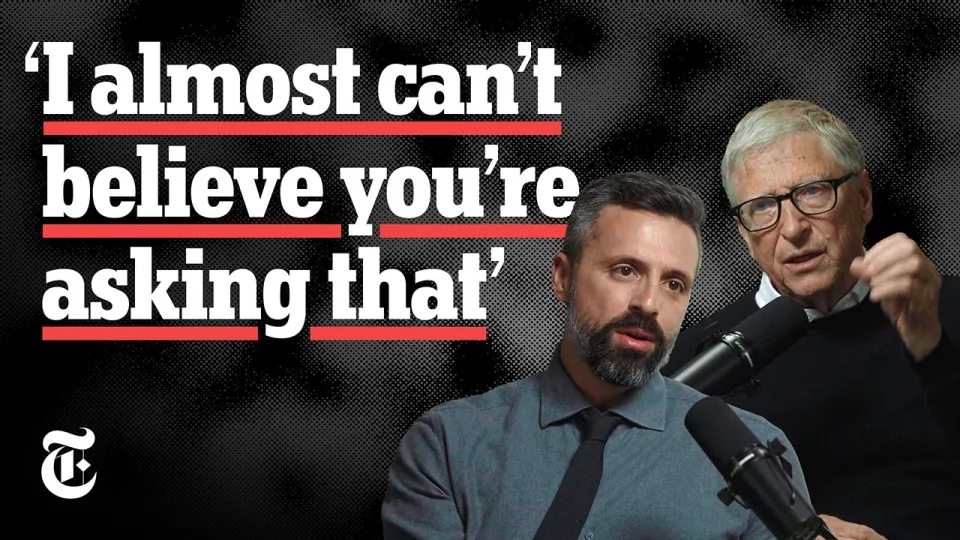
Bill Gates argues that artificial intelligence is the most dangerous technology humanity has ever approached, and that even the loudest AI alarmism has not gone far enough. In a conversation with Ezra Klein, he warns that the coming years will bring catastrophic cyberattacks, bio-terrorism and mass job loss unless governments act, and he calls the belief that the AI industry can police itself "insane." The full interview and transcript are available through The Ezra Klein Show episode page on NYT Opinion.
Gates is not a newcomer to technological risk. As Microsoft's co-founder and the chair of the Gates Foundation, he has spent two decades arguing that the world underinvests in pandemic preparedness. What changed is the speed at which AI capabilities have moved from impressive to superhuman in narrow domains, and his conclusion that the institutions meant to manage that shift are in denial about what is coming.
What Gates used to think about AI and why he changed his mind
Gates was for years one of the more optimistic voices on artificial intelligence, treating it as a tool that would accelerate progress in health, education and productivity. That optimism has not disappeared, but it now sits alongside a much darker assessment of the transition period. The turning point, as he describes it, is the moment AI systems began to outperform humans at specific tasks rather than merely assist them.
His shift mirrors a broader pattern in technology forecasting: experts tend to underestimate how quickly a capability crosses from unreliable to better-than-human once it becomes economically valuable. Gates points to the compounding effect of AI helping design better AI, which shortens the distance between each generation of models. The practical consequence is that the window for governments to write rules, build monitoring capacity and prepare labor markets is measured in a few years, not decades.
Cyber and bio thresholds are the real red lines
Gates identifies two thresholds where AI risk stops being abstract and becomes a matter of mass casualties: cyber and bio. On the cyber side, he warns of attacks that could disable power grids, financial systems or water treatment at a scale no single company or country has defended against. On the bio side, he worries that AI could lower the barrier to designing and producing dangerous pathogens, turning what once required a state laboratory into something a small group could attempt.
His framing is deliberately mechanical rather than moral. The question is not whether AI is malicious but whether the cost of causing harm falls faster than the cost of preventing it. When a capability becomes cheap enough, deterrence by law enforcement or corporate policy stops being credible. That is why he treats these two domains as the place where regulation must arrive first, before the general-purpose debate about AI alignment is resolved.
Why self-regulation fails and lawsuits are not a remedy
Gates is blunt that the AI industry cannot regulate itself, calling the idea "insane." His argument rests on incentives: a company that slows down to conduct safety work cedes market position to a competitor that does not, and shareholders reward speed. Voluntary commitments therefore hold only until they become expensive.
He is equally dismissive of the idea that liability and litigation can substitute for rules. If a system causes harm at the scale of a hundred million people, no lawsuit can repair the damage or deter the next actor, because the damages exceed any company's balance sheet and the causal chain is too diffuse for courts to untangle. Regulation has to work ex ante, through licensing, testing thresholds and mandatory reporting of dangerous capabilities, rather than ex post through courts.
The race with China and the coordination problem
A recurring tension in the conversation is that the United States and China are competing for AI leadership while facing the same catastrophic risks. Gates does not propose that either country slow down unilaterally. Instead he argues that the risks that matter most, cyber and bio, are inherently international: a pathogen or a network attack does not respect the border of the country that built the model.
That makes coordination both more necessary and harder. The historical analogy he reaches for is nuclear arms control, where adversaries managed to agree on inspection and limits despite deep hostility. His point is that AI governance needs similar technical channels, shared red lines and verification mechanisms, and that waiting for domestic consensus before engaging internationally will waste the years when the rules could still be written.
How AI will disrupt jobs and what a no-scarcity labor market means
Gates expects AI to compress the time between a task becoming automatable and the people doing it losing income. White-collar work that involves reading, summarizing, drafting and analyzing is exposed first, which inverts the older assumption that automation hits manual labor before knowledge work. The result is a labor market shock that arrives faster than retraining programs can respond.
He sketches a longer-term picture in which productivity gains make goods and services cheaper, potentially producing a no-scarcity economy where the binding constraint is distribution rather than output. Getting from here to there requires policy choices he lists explicitly:
- Taxing AI-driven labor and capital gains so that the productivity dividend funds public goods rather than concentrating in a handful of firms.
- Defining "human reserved" categories of work, particularly in care, education and public safety, where society decides that human presence is the point.
- Investing in language technology so that communities outside English-speaking markets are not locked out of the gains.
- Protecting developing economies, which risk losing the low-cost service jobs that were their ladder into the global economy.
The questions viewers keep asking about AI risk
The most common reaction to Gates's warnings is a version of the same doubt: if the risk is this large, why is the industry still shipping at full speed? Gates's answer is that competitive pressure and genuine uncertainty about which capabilities are dangerous make unilateral restraint irrational for any single lab, which is precisely why the constraint has to be collective.
A second recurring question is whether his fear is credible given his own investments in AI companies. He does not treat that as disqualifying, but it does explain why he emphasizes structural rules over personal virtue: the point of regulation is to make safety the profitable path, not to rely on founders choosing caution. A third is whether AI alarmism is overblown compared with climate change or pandemics. Gates ranks AI alongside those threats rather than below them, because it can amplify both.
What the Gates Foundation plans to do about inequality
The Gates Foundation is set to spend down around $200 billion over the next two decades, and Gates has named making AI a force for equality a new priority. The concern is straightforward: if the benefits of AI accrue mainly to wealthy countries and well-capitalized firms, the gap between rich and poor widens at the exact moment when cheap intelligence could have narrowed it.
He points to education and health as the highest-leverage applications, including tutoring systems and diagnostic tools that could reach people who have never had access to either. The foundation's role is not to build models but to fund the public goods, evaluation and delivery infrastructure that markets underprovide. On education specifically, he acknowledges learning loss in rich countries as a cautionary tale: technology deployed without attention to how students actually use it can deepen gaps rather than close them.
Useful links
- Full episode and transcript of Bill Gates on The Ezra Klein Show
- Book recommendations from guests of The Ezra Klein Show
The bottom line on AI risk
Gates's message is less a prediction than a warning about timing: the capabilities are arriving faster than the institutions meant to govern them. He rejects both the complacent view that markets will self-correct and the fatalistic view that nothing can be done, arguing instead for licensing, testing thresholds and international coordination on cyber and bio risks. The labor market, in his account, needs explicit policy choices about taxing AI-driven gains and reserving some work for humans. This analysis draws on the conversation published by The Ezra Klein Show, and the full episode page is the place to hear the argument in Gates's own words.
Questions & answers
Why does Bill Gates say AI makes nuclear weapons look like nothing?
Gates argues that nuclear weapons are bounded by physical supply chains, treaties and detectable tests, while AI capabilities can be copied, improved and deployed by small groups almost instantly. The scale of potential harm from cyber or bio misuse, combined with the difficulty of monitoring model development, is what he means by the comparison.
Does Gates support pausing AI development?
He does not call for a unilateral pause, which he sees as ineffective while competitors continue. Instead he favors licensing regimes, mandatory testing at capability thresholds and international coordination on cyber and bio risks, so that safety becomes a condition of participation rather than a voluntary choice.
What does he mean by a no-scarcity job market?
Gates describes a long-run scenario where AI-driven productivity makes many goods and services far cheaper, shifting the policy problem from production to distribution. Reaching that outcome depends on choices such as taxing AI-driven labor gains, funding public goods and defining categories of work reserved for humans.
How does the Gates Foundation plan to use AI for equality?
With roughly $200 billion to spend down over two decades, the foundation has made AI-driven inequality a priority. Its focus is on funding evaluation, delivery infrastructure and applications in health and education, such as tutoring and diagnostics, that markets are unlikely to provide to low-income populations on their own.
Source: Bill Gates: A.I. ‘Makes Nuclear Weapons Look Like Nothing’ | The Ezra Klein Show · Markdown version